
The second major change I made was the center diff oil. Both the unit and oil was changed multiple times. See changes below
-
Diff unit 1 - 10k oil
-
Diff unit 2 - 15k oil
-
Diff unit 1 - 20k oil
Calculating the speeds
I'm analyzing the center diff in this case but I'm not measuring center diff outdrive speeds. Instead I measure the motor RPM and rear outdrive speeds. Center diff outdrive speeds are calculated from measured speeds. Rear propshaft speed is averaged from rear diff speeds. Front propshaft speed is calculated as delta from motor speed and rear propshaft speed.
Math channel formulas from Analyzer are as follows.
Speed Rear = ([speed-rl]+[speed-rr])/2
Speed Front = [speed-motor]*2-[speed-rear]
All the charts below are calculated so that they present the car speed in km/h.
Center diff vs rear diff
One nice way to visualize diff slip is to plot outdrive speeds as a 2-dimensional scatter plot. Slip in this context means that outdrives rotate at different speeds and there can be many reasons generating the speed difference like cornering, bumps, wheel spin. The question is how much speed difference the diff allows.
If you have a fully locked diff then you have one diagonal line from bottom left corner to upper right corner. The more slip you have, the more the shape expands. XY plot doesn't give you details what the diff does in corner entries, apex and exits but you will get an overview of how the diff operates in different speeds.
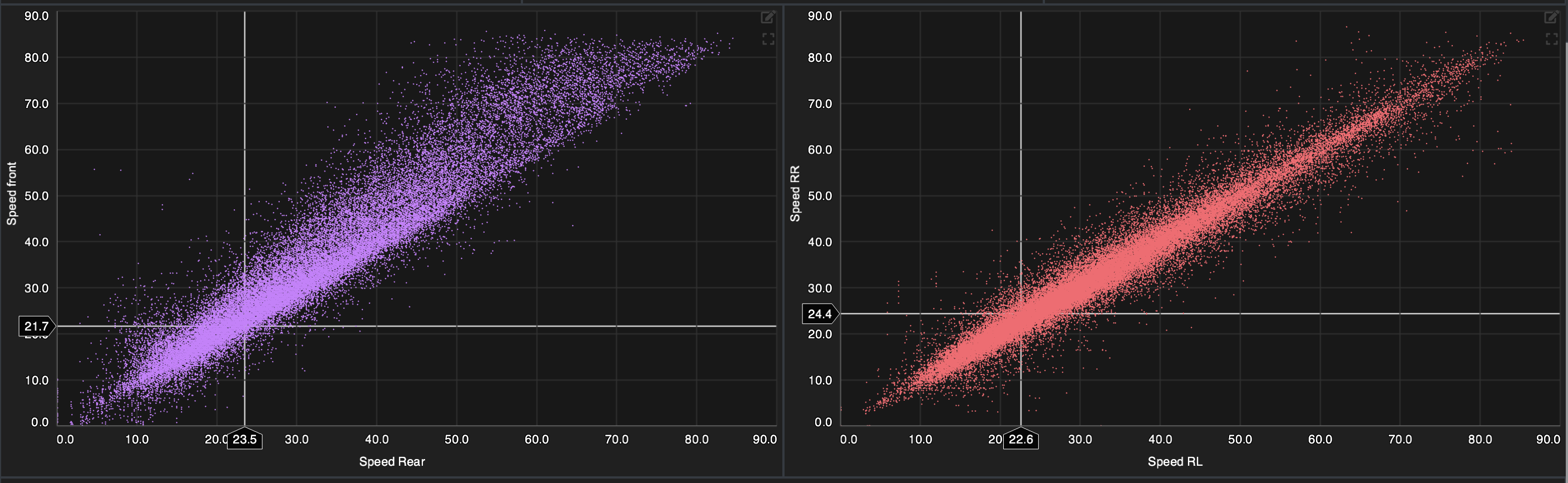
The image below shows the difference on how different the behavior is between center diff and rear diff as scatter plot. Purple represents center diff and red represents rear diff. Center diff chart has front propshaft speed on y-axis and rear propshaft speed on x-axis. Rear diff chart has left and right outdrive speeds in the same manner.
In the center diff almost all slip is on the front side. Center and rear diffs naturally have different characteristics. However, without a mechanical engineering background it feels surprising that we accept losing so much of the drive to the front axle, where it mostly turns into wheel spin rather than producing longitudinal acceleration. Of course it's not so straightforward as the cars are overpowered, the car is a sum of all components like geometry, suspension and transmission. Not to mention the track conditions like grip, surface smoothness and jumps.
Still can’t help thinking what if center diff performance could be improved so that power is delivered more effectively to the front axle, could the car make a significant step forward in longitudinal grip? This would likely need improvements to front and rear diffs to handle the available power.
Or is the current approach already the best compromise between drivability and performance?
Center diff oil
Below there are comparisons between three different oils which are all from the same manufacturer. Two different units are used. By using a scatter plot we aim to visualize the impact of the diff oil change.
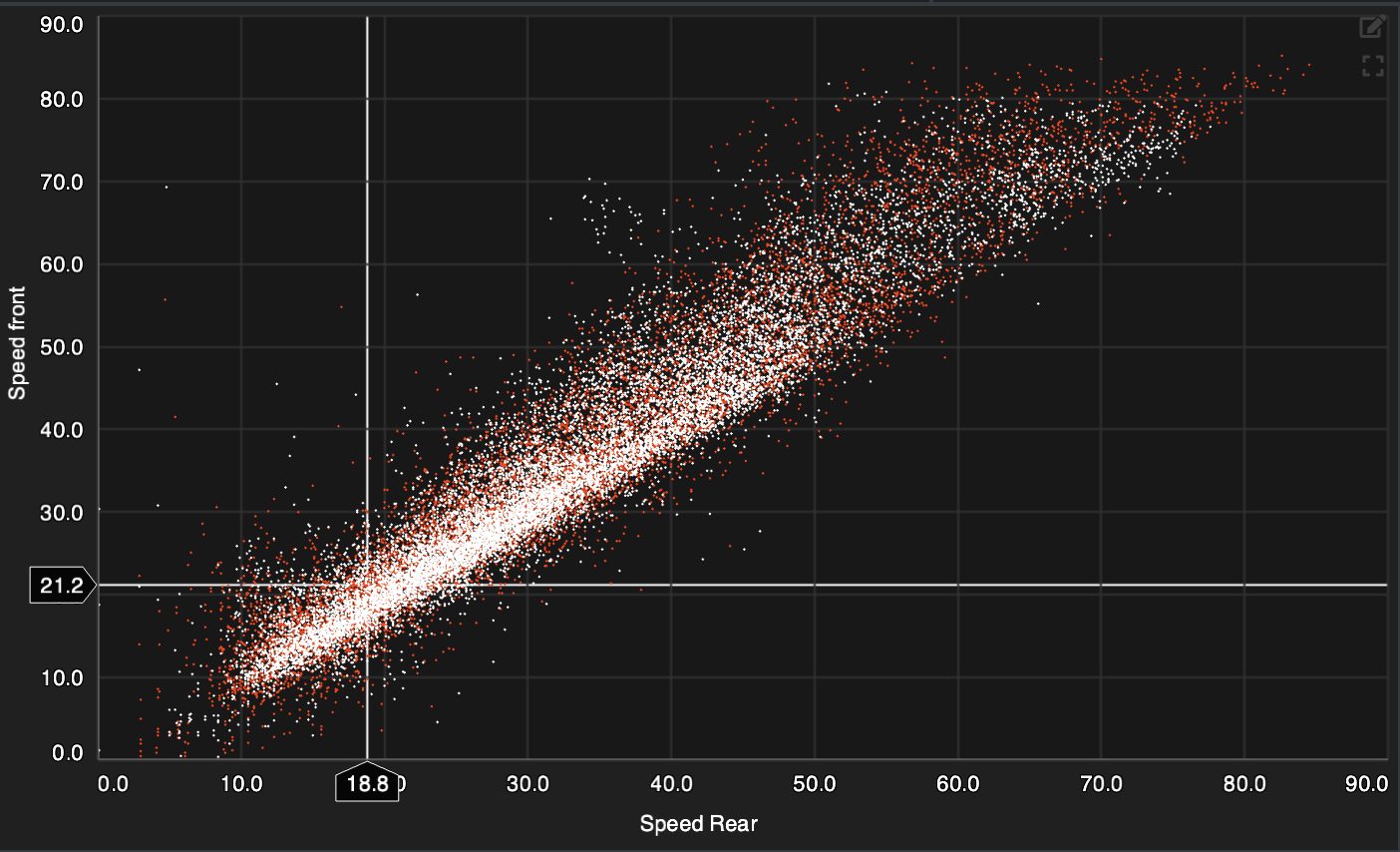
Diff 1 with 10k (white) vs diff 2 with 15k (red)
Surprisingly, the 10k diff appears slightly tighter or equal to the 15k diff. This suggests that the diffs are not built identically. The diff was just handed to me, so it would need additional investigation into what is behind the difference.
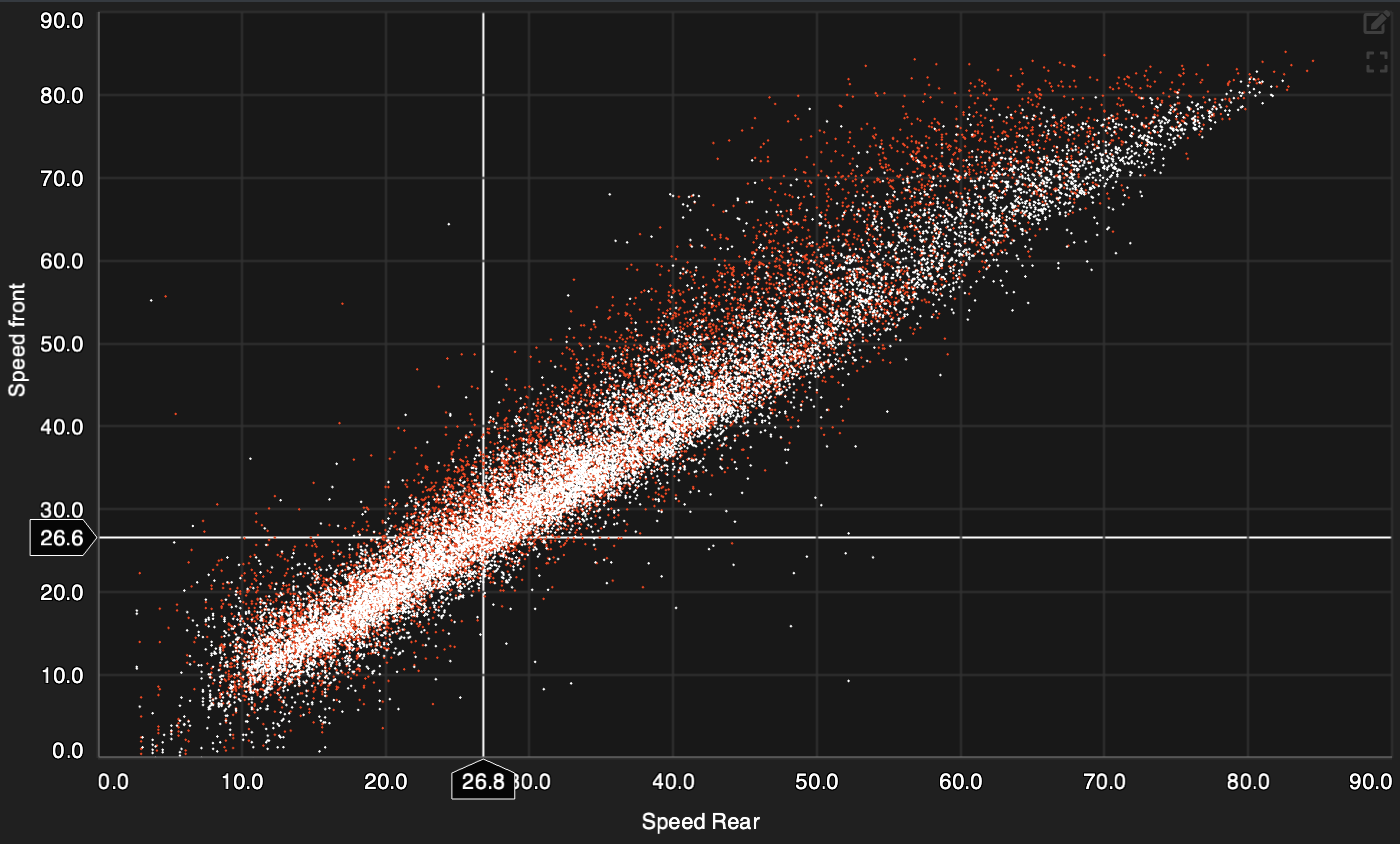
Diff 2 with 15k (red) vs diff 1 with 20k (white)
Now the 20k diff shows a narrower speed distribution compared to the diff with 15k oil. This is the expected result, but we must keep in mind that a different unit is being used, so the visible oil impact may be smaller than it appears. In previous example, unit 2 with heavier oil had almost similar speed distribution as diff unit 1 with lighter oil.
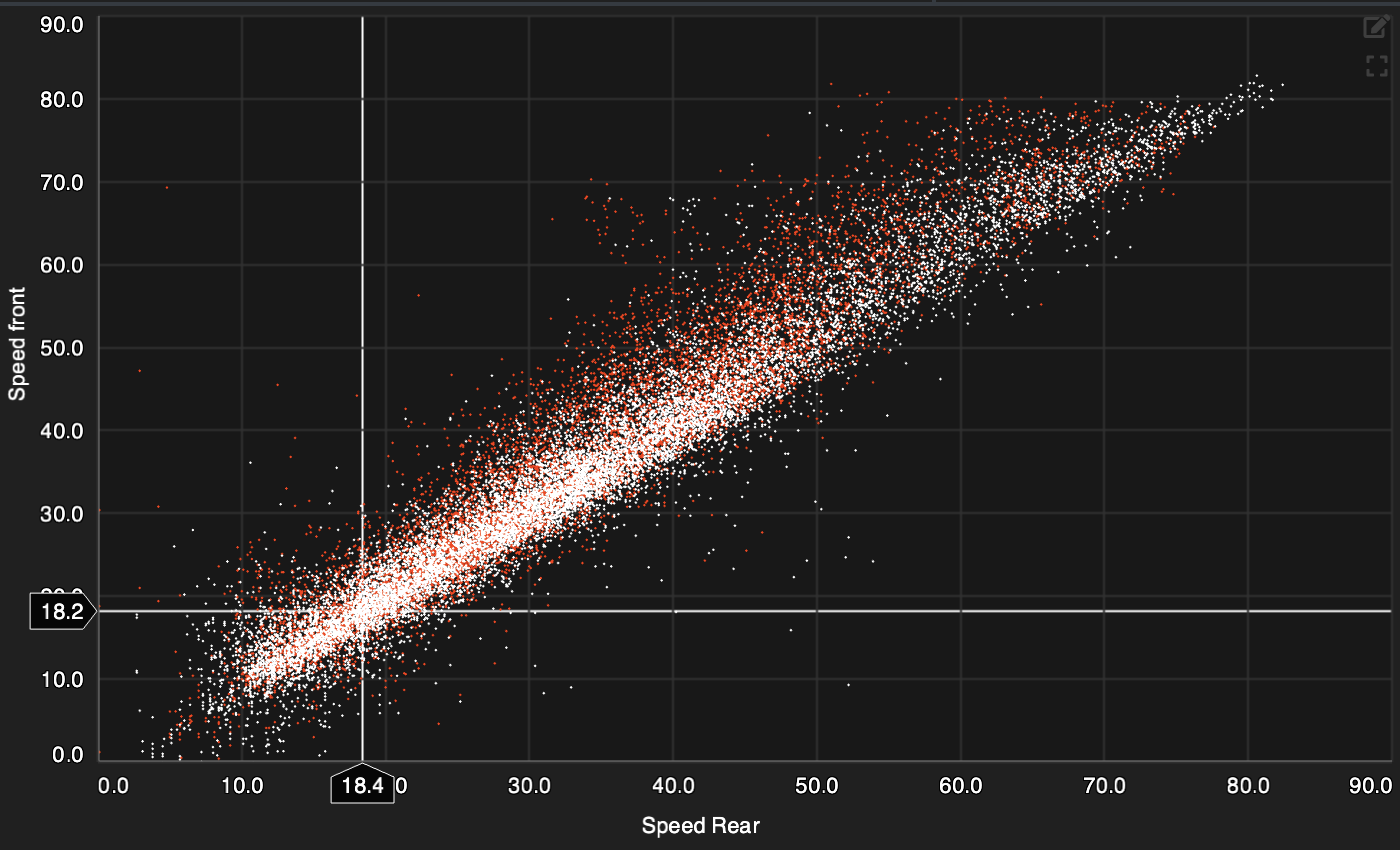
Diff 1 with 10k (red) vs diff 1 with 20k (white)
This comparison uses the same diff unit with different oil. This comparison shows more clearly the diff oil impact as the 20k oil has a clearly narrower distribution.
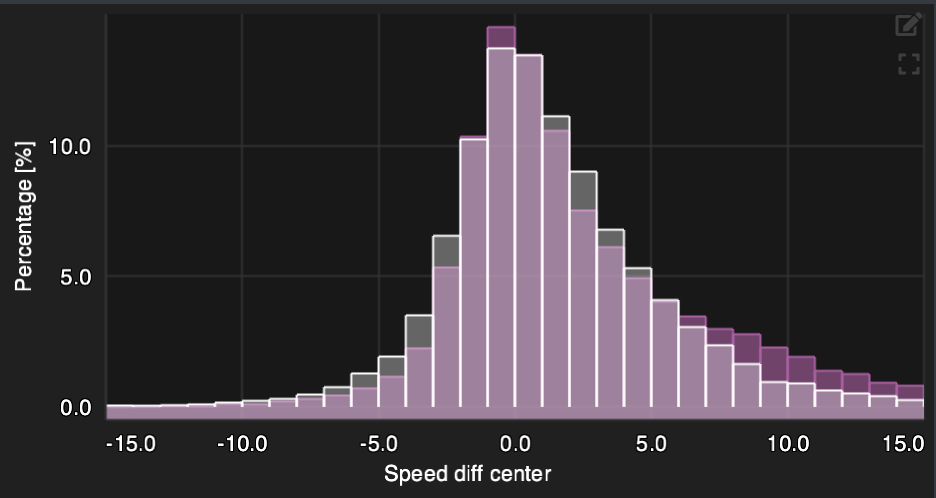
For this example I also took the speed difference histogram which shows the distribution of speeds differences. where you can see that lighter oil allows more slip to front. Positive values indicate that the front propshaft is spinning faster than rear propshaft. In this image purple presents diff 1 with 10k oil and white is diff 1 with 20k oil.
Driver feedback and laptimes
Balance was better with tighter center diff and clean run
Changing the diff from unit 1 with 10k oil to unit 2 with 15k oil gave a positive feeling.
The car was way too aggressive when going to throttle when having 20k center diff oil. Really difficult to compete with others and generated a lot of mistakes.
Comment was very negative after changing the diff from unit 2 with 15k to unit 1 with 20k.
When you can see the data, it all makes sense. During the race I was very confused how a relatively small change to the diff made such a massive difference in feeling.
How are the lap stats after the changes?
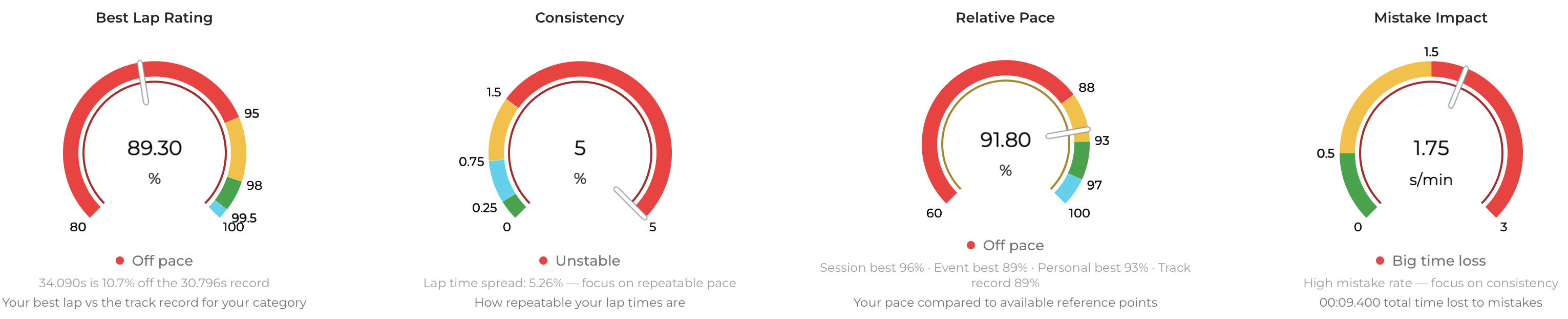


The lap times indicate that performance potential was better with 20k diff oil, but consistency was significantly better with unit 2 using 15k oil.
Conclusion
The 2D scatter comparison is just the first phase and you could analyze the data in more detail by checking what happens during braking, cornering and acceleration by using more channels than only speed. Maybe someday I will take the time to write an article on how to do this after doing a bit more research around the topic.
I would also like to do some research on the mechanical aspects of the diff. For example how much shimming, gears and oil lifecycle impact the diff performance.
But after putting everything together from this analysis, I would first want to understand why diff unit 1 was behaving so differently compared to unit 2. After that is solved, I would start moving to heavier oil with unit 2 until the limit is reached.